Wednesday, November 29, 2006

Upcoming: The Principle of Charity

I'm taking a quick break from working on my research project to note an idea I had for an upcoming installment of Distilled Wisdom: The Principle of Charity. It keyed in my mind after reading the following comment over at Dangerous Intersection:

To really “fight fair,” Step One is to put one’s opponent’s best foot forward. Otherwise, every argument is a straw man argument.


I can't guarantee this will be out soon, as I still have one more sample article and a cover letter to write, but I thought I'd give those of you waiting a little taste of what's up next.

Proceed with your information binge...

Monday, November 27, 2006

The Demarcation Problem

The following is an essay I submitted for one of my classes last year. It deals with the demarcation problem of science, so I figured you might find it interesting.

The field of science has been responsible for many significant steps forward in civilization, and true scientists are granted great amounts of respect in modern society. As such, many pretenders find it beneficial to claim to be scientists themselves. This makes the Demarcation Problem—distinguishing science from non-science, pseudoscience, and religion—an important issue and possibly a useful tool in exposing these pretenders. In this paper I intend to examine the history of demarcation, analyze the boundaries of science with non-science, pseudoscience, and religion, and propose standards for distinguishing science from these fields.

- - - - -

The first attempt to demarcate science came from the Vienna Circle, a philosophical society formed at the Vienna University in 1922. They developed the theory of Logical Positivism, which stated that the only meaningful statements were ones that were derived from empirical observations (also known as verificationism). This most clearly demarcates science from religion (which was their particular goal), in that it implies that religious and metaphysical statements are meaningless. There were problems with this theory, however. For one, it failed to distinguish fields such as art, which is also based on empirical knowledge (though generally artificial and subjective), from science. The theory also inadvertently condemned mathematics as being meaningless, as it wasn’t based on empirical evidence.

These problems were noticed by the philosopher Karl Popper. He pointed out that a theory could be meaningful without being scientific and that a standard of meaningfulness would not necessarily coincide with a demarcation of science. Popper’s proposed alternative was falsificationism: If a theory is falsifiable, it is scientific; if a theory is not falsifiable, it is not scientific. This theory has shown to be much better at demarcating science than verificationism was. Using the example above, art shows no falsifiability as the field is highly subjective, and each person is entitled to their own artistic preferences. Also, since mathematical theorems are proven, they are not falsifiable and thus not scientific—though this doesn’t mean that they aren’t meaningful or useful for science.

Falsificationism has some problems of its own, however. Almost every theory or paradigm has certain anomalies which could be said to falsify it. However, due to the statistical nature of many experiments, if a large number of experiments are done, it becomes inevitable that some will display seemingly anomalous results. Falsificationism also has the curious property that it makes many mundane statements scientific. For instance, the statement, “My eyes are blue,” could be falsified if the one looked at the speaker’s eyes and found that they were not blue, so under falsificationism, it must be a scientific statement.

The most recent views on the demarcation of science come from Thomas Kuhn. He stressed that science operates in two different manners: what he calls “normal science” and “extraordinary science.” Normal science is mostly a problem-solving phase, where scientists solve problems within the current paradigm. In this phase, the standard of falsificationism still has merit. Extraordinary science is what happens once a significant number of anomalies has built up, making the current paradigm no longer viable. A new paradigm is developed at this time, and the scientific community undergoes a “paradigm shift” and gradually switches. Since all paradigms have anomalies, particularly at their early stages before they’ve been fully refined, a strict interpretation of falsificationism would rule out all of these new paradigms almost immediately. This isn’t what the scientific community judges, however. The new paradigm is judged on its ability to solve problems. If it solves more problems or more important problems, it is generally accepted over the previous paradigm. Thus, in this stage, the standard of whether a paradigm is scientific is its ability to solve problems in normal science.

- - - - -

Distinguishing science from non-science or religion is generally a simple matter, as the two generally make no claims to be scientific. When they do make claims of being scientific, they become pseudoscience. Even so, it is useful to recognize the distinctions, as science doesn’t always specifically declare itself as such. For the boundary between science and religion, the verificationism view works quite well in the majority of cases. Science deals primarily with empirical matters, while religion deals primarily with spiritual matters, which cannot be empirically and objectively observed.

Occasionally, however, these will overlap. Religion might make claims about empirical matters, or science might make claims about unobservable phenomena. In these cases, the methodology of the two is what differentiates them. Science relies on objective experiments to gain knowledge, and there is a high degree of community in it that helps to confirm or disconfirm theories and settle debates between paradigms. Religion is more subjective, and every individual has a different interpretation. Due to its objective nature, two individuals practicing science within the same paradigm will generally come to the same result. In religious debates, disputes are attempted to be settled by appeal to authority—generally, the word of the clergy, holy texts, or a prophet—but this is never perfect due to the subjective element, and there will always be different interpretations of a religion.

When distinguishing science from non-science, it’s easiest to start by defining the core of what science is, and then define non-science as the fields which fall outside this definition. At it essence, science is a system of acquiring knowledge about the physical world through objective experimentation and observation. Therefore, we can immediately classify fields such as art and business, which do not involve the acquisition of knowledge, as being non-science. Mathematics, which doesn’t acquire knowledge about the physical world, is also non-science. Engineering is focused on the practical application of scientific knowledge, so while engineers may practice science at times, the field as a whole is non-science.

There is also the subdivision of science known as the social sciences, comprising fields such as history, economics, and sociology, to consider. They use methods similar to the natural sciences, but study human behavior instead. One large limitation they have is that experimentation is rarely feasible, and so all studies must be observational. This makes it a lot more difficult to test theories, and the unpredictability of human nature only adds to this problem. But just because a field comes with difficulties doesn’t mean it can’t be scientific—it just isn’t as reliable. The social sciences do fit many of the criteria of science, but it is necessary to keep in mind that due to the complexities of human nature, the results aren’t as reliable as those obtained in the natural sciences.

Now we come to the division between science and pseudoscience. Pseudoscience can be defined simply as something which claims to be scientific but isn’t. Classic examples of pseudoscience include astrology and the belief in ESP. The belief in the existence of ESP provides a good example of how falsificationism can work to classify it as pseudoscience. Since it’s impossible to analyze every event on earth taking place at any time in history, it would be impossible to prove that there isn’t at least one legitimate case of ESP. As such, it’s impossible to falsify it, so it’s unscientific.

Astrology, on the other hand, is a field for which falsificationism fails us. Since it relies on predicting the outcomes of earthly events from analyzing the stars and other planets of our solar system, it could theoretically be falsified if these predictions are false (or show no statistical improvement over random, similar predictions). In fact, this is exactly what has happened. Experiments have been done repeatedly with astrology showing that its predictions show no statistical merit. But the fact that some experiments have been done which falsify it isn’t enough to say it’s unscientific—all paradigms and theories have had a small number of experiments performed which give contrary results. It is simply the result of random chance that with a large number of experiments performed, some will have extraordinary results. Even if many or most of the experiments give evidence against the theory, it’s still possible that the theory is correct and this was just an extraordinary occurrence.

If we were to rely solely on falsificationism, we would be forced to accept that those who practice astrology are practicing a science. Therefore, it’s apparent that we will need a further standard to judge whether falsifiable fields are scientific. For this, we can use some of Kuhn’s views on science: primarily that it is, in the end, a communal practice. Therefore, we can rely on the opinion of the scientific community on whether or not a theory actually has been falsified. In the case of astrology, this is most definitely the case; the chance of all of the experiments which disprove it being the result of random chance is so slim that astrology can safely be said to be falsified, and thus is a pseudoscience.

There is an obvious problem in applying this standard too strictly: All new paradigms and theories go through a period in which they are put on trial by the scientific community, and it is the norm that they are presumed “guilty until proven innocent.” Because of this, we must make an important distinction. Newer paradigms and theories that have yet to be fully fleshed out and whose “trials” have yet to be resolved are classified as “protosciences.” These protosciences shouldn’t be classified as pseudosciences as they haven’t been dismissed by the scientific community. But conversely, they also shouldn’t be given the weight that established sciences have, as they have not yet proven their merit. An example of a modern protoscience is String Theory, which roughly states that subatomic particles are shaped like coiled strings, and the different motions of these strings correspond to different properties and interactions of the particles. At this time, the proponents of String Theory have some evidence which could be said to support this theory, but they don’t have a way to test it—it isn’t falsifiable. It will possibly become falsifiable at some point as the theory evolves, and it is not immune to scientific review, so calling it a pseudoscience would be a definite misnomer.

- - - - -

One of the reasons that demarcation is an important problem is in the admissibility of scientific testimony in court. “Junk science”—the popular term for pseudoscience—has been showing up in an alarming number of lawsuits in attempts to win money when there is no actual merit to the case. Up until 1993, the preferred method for accepting scientific testimony was for the judge to determine simply whether the evidence presented had “gained general acceptance in the particular field in which it belongs.” While this standard was reasonable, it was often impossible to apply it. How would the opposing attorney prove that the evidence was not generally accepted? A disagreeing expert could be brought in, but how would that expert prove to be more reliable? The difficulty here was what allowed so much junk science to sneak through.

In essence, the legal system needed to come up with its own demarcation between science and pseudoscience that was simple enough for the judge to understand and apply. This was done in the Supreme Court’s opinion of the case of Daubert v. Merrell Dow Pharmaceuticals in 1993. The “Daubert Standard” included two measures by which an expert’s testimony would be admissible: relevancy and reliability. The relevancy prong is simply whether the testimony is relevant to the case. For instance, a chemist could testify that acid could be used to burn off one’s fingerprints, but if fingerprints were actually found at the crime scene this piece of information could be deemed irrelevant. The reliability prong was the part used to determine whether the testimony was actually scientific. The Supreme Court gave “general observations” of what made scientific testimony reliable, though they stressed that it wasn’t supposed to be an exacting checklist:

  • Empirical testing: the theory or technique must be falsifiable, refutable, and testable.
  • Subjected to peer review and publication.
  • Known or potential error rate.
  • Whether there are standards controlling the technique's operations.
  • Whether the theory and technique is generally accepted by a relevant scientific community.
The first point here is simply the falsifiability criterion. The fifth point shows a critical divergence from asking for communal acceptance of the theory; it asks only for communal acceptance of the methods used to obtain this theory (this is also the intention of the fourth point). This is important as it allows for novel ideas and evidence to be presented, as long as they were arrived at in a scientific manner. The second and third points are most important within the legal context for which this standard was intended. The second point means that the testimony has been exposed to the possibility of criticism from the scientific community, so if the evidence presented has been argued heavily against, it would be easy for the opposing council to show this. The third point also opens up a possible argument if the error rate is high; the opposing council could argue that this high error rate decreases the reliability of the testimony as evidence.

- - - - -

This gives us the following three-step process in order to determine whether a theory is scientific: First, determine whether the theory is potentially falsifiable (a good measure of whether it’s empirically-based). If it’s falsifiable, determine whether the methods used to obtain it are generally accepted by the relevant scientific community. Finally, examine the criticism of the theory by the scientific community, and whether or not this warrants claiming that it’s falsified. If it’s falsifiable, obtained in a scientific manner, and hasn’t been falsified by the scientific community, then it’s scientific. This method isn’t perfect, and one should keep in mind the aforementioned classifications of social sciences and protosciences which may or may not end up classified as science under this standard. Of course, science is ever-evolving, so many sciences of today will likely become obsolete, just as Phlogistics and the Geocentric Theory have. In their day, they were scientific, but if one were to practice them today, they would be pseudosciences.

Proceed with your information binge...

Friday, November 24, 2006

*Sigh*

*Glare*

The choice to live or not to live

To the editor,

First of all, the repeated use of "fuck" does not make your article (“Let’s put this mercy killing to rest,” Imprint Volume 29, Issue 17) any stronger. It makes you sounds like a raving imbecile. Let me ask you: How would you like to have an illness where your brain continues functioning fully but you are slowly trapped inside a dead body? You’re not able to communicate, eat, move or show emotion. You’re stuck in bed soiling yourself with a tube shoved in your body feeding you liquid food. Yeah, sounds like the natural way of life!

And you think the family members would be hurt and abandoned if the person wanted to have their miserable, painful existence ended? It is absolute torture to see someone you love live with excruciating pain every single day of their life. Consider watching an 80-year old man slowly revert back to child-like functionality. being unable to dress themselves and being forced to use a diaper. You say it’s selfish to die; I say it’s selfish to live!

I hate to break it to you, but the Bible is religion, so don’t try to shove it in our faces as an argument! Religion is becoming less and less popular as science evolves. I know almost as many atheists and agnostics as I do religious people. Bringing religion into the debate has become an invalid argument!

The euthanasia movement is not about forcing people into their graves. It’s about giving people a choice. If you want to live through a disease that eats away at your body, go ahead it’s your life! But if I choose not to suffer through the the remainder of life, I should, at least, be able to opt out of having my mind and body ravaged by disease!


*Grumble*

Who are you calling a gay Nazi?

Black people should sit at the back of the bus. The Holocaust never happened. Oh, I’m sorry. Was I offensive? I was just trying to be funny. Let’s get it straight. Brendan Pinto’s recent distasteful attempt at being funny in his “satirical” article was homo-negative and was taken adversely by the majority of the campus gay community.
I’m sure right now a few of you are throwing your hands up in exasperation and mumbling “lighten up” or something about the freedom of expression. Well, let me take you through a history lesson to enlighten you why calling a part of the gay community “Lesbianazis” and the “Gaystapo” is sacreligious on many levels.

In 1934, the Gestapo, the secret police of Germany’s Nazi party were instructed to compile a list of gay individuals. This list was then used by the Nazis to round up gay men in all of Germany and try to get them to give up their “immoral” lifestyle and if they refused, they were put in concentration camps alongside the Jews of the Holocaust under the “Extermination through Work” policy carried out by the Nazis. Over one million gay German men were targeted with roughly 100,000 of them being arrested and half of them serving as convicts in concentration camps simply for their chosen expression of love. That number does not include hundreds more men who were castrated by the Nazis because they refused to adopt the straight lifestyle.

Now that we had that enlightening detour through history let me come back to Pinto’s recent apparently “non-homophobic” article and point out why expressions like Lesbianazi and Gaystapo are just as much if not more hurtful than calling an Israeli citizen a Judeo-Nazi. You just don’t do that. Millions of people sacrificed their lives for their way of life not so that certain wannabes can go around poking humour at these people’s sacrifices.

Our great country values the diversity among our ranks and the freedom of expression that all of us have benefited from. But another great nation, contemporary Germany, has a beautiful motto and that is “Never again.” Never again will the atrocities of the Holocaust be committed. My hope is that Canadians choose to be as responsible and sensitive in their actions and realize that the apparent comforts of today are the result of countless sacrifices deserving of the utmost respect and dignity.


*Growls, points*

*Roars, points*

GyyaaaAARRRGGGHHH!!!

*Goes into an Incredible Hulk-like rage*

Proceed with your information binge...

Wednesday, November 22, 2006

Given the current trend of the AMSA...

We might all want to take a page from the recent Skeptic's Circle and write out our last wills and testaments. You never know, the doctor in charge of saving your life might just be a fan of a good old colon cleansing.

"What's up with the AMSA?" you ask. Orac has the story.

Proceed with your information binge...

Tuesday, November 21, 2006

Blatant Boneheadery

Blatant Boneheadery: When someone makes an argument so ridiculously idiotic in face of facts to the contrary that, if they're serious, their sanity is in doubt.

Example 1: John Kerry botched a joke. He meant to say, "[If you don't get an education], you get us stuck in Iraq." He instead said, "...you get stuck in Iraq." He then explained what had happened, saying he had left out the word "us." And now, the blatant boneheadery this explanation was met with:

Tony Snow, current White House Press Secretary, criticized this as follows, "He said he meant to say 'us' - I mean, 'You us get stuck in Iraq?' It's ridiculous!"

He's either lying through his teeth when he says this must be what Kerry meant, or he's an utter bonehead. But then again, who but an utter bonehead would be Press Secretary for Bush? But I digress...

Example 2: The following is excerpted from Bronze Dog's reply to that insane troll, Weapon of Mass Intruction:

God has never murdered nor raped.

Ever heard of the flood?

Ever read about all the massacres in Joshua?

Ever read Numbers?

Sounds like murder and rape to me. He may not have done all of those acts himself, but commanding them is just as bad.


Here's Weapon's reply, spread out pointlessly over three posts just as he did:

Weapon of Mass Instruction said...

Ever heard of the flood? Ever read about all the massacres in Joshua?


Funny. I find no examples of rape. Apparently you have a hard time differentiating between killing murder. I assume that you also believe that our American troops are murderers as well.

11/21/2006 12:22 PM
- - -
Weapon of Mass Instruction said...

The fact is that if God were a murderer he definitely would have not died on the cross for you.

11/21/2006 12:23 PM
- - -
Weapon of Mass Instruction said...

Sounds like murder and rape to me. He may not have done all of those acts himself, but commanding them is just as bad.

Well, I do not know where you see him commanding rape, but for someone who has a fanatical hatred towards God, it is not surprising that you would make up lies about him.

According to your hermeneutic you are liable for murder too every time you eat chicken.

11/21/2006 12:27 PM


You catch it? He says that he didn't see any instance of God commanding rape, but this is only because he completely skips over the reference to God commanding rape. Given my past experience with Weapon, I'm betting on this being because of his severe brain damage.

These are just a couple examples, but they both come from (supposedly) functioning human beings. It kind of makes you fear for humanity.

Proceed with your information binge...

Sunday, November 19, 2006

AAA: Aliens Against Anal (Probing)

Just saw this clip on TV, and had to share it. This is probably the best (or at least funniest) argument against the reality of alien abductions I've seen. Enjoy.

Proceed with your information binge...

Saturday, November 18, 2006

Quantum Mechanics for Dummies #1: Wave Nature of Matter

I got into an involved explanation of Quantum Mechanics a few days ago over at Bad Astronomy, and it reminded me of an idea for a series of posts I've had on the backburner for a while. In this series, my goal is to make Quantum Mechanics somewhat intelligible to those who haven't studied it and clear up some common misconceptions about it.

In this first post in the series, I'm going to discuss what Quantum Physicists call the wave nature of matter, and how a particle can act like both a particle and a wave. But before we go into that, I should explain by what we normally mean by "particle" and "wave."

First, in a classical sense, what is a particle? Particles are generally very small, and possibly infinitely small, being just a point in space. They can have numerous properties such as mass, electric charge, and magnetic moment, which determine how they act and interact in the universe. When they travel from place to place, they do so with a definite, linear path.

Second, what is a wave? Waves are a bit harder to explain, so I'll go with what Wikipedia says on it:

A wave is a disturbance that propagates through space or spacetime, often transferring energy. While a mechanical wave exists in a medium (which on deformation is capable of producing elastic restoring forces), waves of electromagnetic radiation (and probably gravitational radiation) can travel through vacuum, that is, without a medium. Waves travel and transfer energy from one point to another, with little or no permanent displacement of the particles of the medium (there is little or no associated mass transport); instead there are oscillations around fixed positions.


Waves also have properties associated with them, but they're generally different from particles. First, there's amplitude, which is, in a simple sense, the height of the wave. There's also frequency, which is how many oscillations a wave makes per second. Frequency and amplitude together determine the energy of the wave (with the energy being proportional to the frequency and the square of the amplitude). Classically, the amplitude and frequency of a wave are both continuous, so a wave with a given frequency can have any value of energy.

Waves also translate in space differently from particles. Instead of simply following straight lines, waves spread out. If a wave passes through a long, narrow corridor, it will spread out at wide angles when it leaves, unlike how a bunch of particles going through the corridor would act. In fact, waves act in the opposite manner to particles in this case as the thinner the corridor is, the more the wave spreads out upon leaving. This phenomenon is known as diffraction.

* * * * *

Classically, light was always seen as a wave. It showed all the expected properties of waves, having a measurable frequency, diffracting, etc. But eventually a problem was found: Light of a given frequency could only have quantized energy. What this means is that essentially if you have light that's all of one frequency, there are only certain set values of its total energy that it can have. For instance, it might be allowed to have energy of 1.1 eV, 2.2 eV, 3.3 eV, and so on, but it could never have an energy of 1.5 eV or 0.5 eV unless some of it is at a different frequency.

This also meant that there was a minimum energy that light could have. If light were made out of particles (what we now call photons), this could be explained quite easily: Each particle would have energy equal to a constant times its "frequency," and they added together to form the total energy of the light. The problem was that particles classically couldn't have frequency.

So we were left with a contradiction, and had to form a new theory. Light had properties of both particles and waves. But was it particles that traveled like waves, or maybe waves that just happened to be quantized somehow? Further experiments were necessary to determine what exactly was going on.

The most famous of these experiments was the Double-Slit Experiment. In this experiment, light first diffracts out of one slit, allowing it to spread out and hit two more slits. The light that passes through each of these slits diffracts again, and the wave then hits a detector.

If a conventional wave goes through this, we see a strange interference pattern on the detector. This is cause by the waves coming from each slits being at different points along their wavefunctions. If one is at a peak and the other at a valley, the amplitudes cancel out and no light will appear at that point. If both are at peaks or valleys, then the amplitudes at together, and since we then square the amplitude to get the energy, we get four times the energy at this point as we'd get from a single wave, or twice what we'd get from two waves. Particles, on the other hand, show no interference patterns. This means that we can use a double-slit experiment to determine whether light is acting like a particle or a wave.
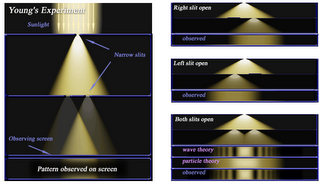
So, this experiment is then performed. A lot of light is shot out, and it does indeed show the interference pattern. So, if light is a bunch of particles, they can somehow interfere with each other, it would seem. We had the technology to decrease the emission rate of light low enough that only one photon was being sent out at a time, so this was the logical next step.

When we performed this experiment, the results were extremely surprising. When you plotted the frequency with which the photon would strike different points of the screen, it matched up with the interference pattern! Even single photons were acting like waves. This is something that just wasn't possible if you treated them like particles. The first problem was that particles wouldn't diffract like waves, but these photons were doing this. The second problem is that, even if particles could diffract, you would expect them to go through one of the two slits, and then diffract onto the detector. The pattern that appears should then be the some of the diffraction patterns from the two slits, but it was instead the interference pattern.

Then things got stranger. We tried firing things that we were pretty sure were particles through a double-slit experiment, such as electrons. They, too, showed a diffraction pattern. We went bigger and shot atoms through it. Same deal. Our record so far has been shooting Bucky Balls (spherical molecules of 60 carbon atoms) through it, and even they act like waves.

It was becoming cliché at this point, but there was an even stranger development still to come. We figured that if these particles were acting like particles, they had to be going through just one of the slits. We then set up detectors at both slits that would tell us if a particle was passing through it. We did so, and we got results from it: a 50/50 spread of particles between the two slits. But there was a problem. When the detector was on, the interference pattern went away! If we turned off the detector, the interference pattern appeared again. Things were seriously screwed up.

Take a few minutes to ponder this. It's taken scientists many decades, and most of them still don't have a good picture of what's actually going on that could cause this. There are a few theories out there, but none are very well accepted. I'm going to go into my personal interpretation of how this works, but remember that there are others.

When any particle is traveling, it does so as a probability wave, that is, a wave that represents the probability of the particle being at a certain point if we measure it. This isn't a theoretical wave (in my picture, at least), and the probabilities aren't simply an oversimplification like in Statistical Mechanics. Instead, the wave is an actual object, and the probability is a fundamental law of the universe.

This probability wave has properties like normal waves, even if it represents a "particle" like an electron. These properties include frequency and the value of the wavefunction at a point. Squaring the value of the wavefunction is what gives us the probability of it showing up in a certain area. Like other waves, if its path is split up, it can interfere with itself, causing an interference pattern in the probability it will show up in an area.

Now, from this description, the more statistically inclined of you might be wondering about one possible problem. Take a simplified case where a probability wave has a 50% chance of resolving into a particle in the right half of an area, and a 50% chance of resolving into a particle in the left half. Also, let's assume that the wave hits the entire area at the same instant of time. Shouldn't the probability distribution look something like the following?

Shows up in right only: 25%
Shows up in left only: 25%
Shows up in both: 25%
Shows up in neither: 25%

Well, the above distribution is only valid if the probabilities are independent. We know from experiments that this isn't the case; a particle will always resolve in exactly one spot. But the wave hits the entire surface at one instant, and Relativity tells us that the speed of light is an upper limit on data transfer. How does the left half of the wave know whether the particle has resolved in the right half, if information can't get there fast enough?

What I've described here is part of what's known as the EPR paradox. Somehow, for quantum mechanics to work the way it does, there must be some form of information transfer from one part of a probability wave to another so that particles don't randomly disappear or split into two. It would seem at first glance that this would violate Relativity, but this isn't quite so. The information you get from it resolving or not resolving in one area is no more than logical inference, and this is all the universe is doing as well. In addition to a basic law of randomness, the universe also seems to have a basic law of inference on the resolution of these waves, so that we end up with conservation of energy.

Well, that's enough for today. If there's anything in there that's still confusing, please leave a comment and ask for clarification on it; I'll be glad to explain.

Note to anyone who already knows some QM: Yes, I'm aware I came very close to talking about entanglement in the last couple of paragraphs, but I chose not to go into detail about it. This is simply because entanglement is getting its own entire post in this series.

* * * * *

Other posts in this series:

Quantum Mechanics for Dummies #2: Observation

Proceed with your information binge...

Friday, November 17, 2006

This post intentionally left blank

Proceed with your information binge...

Wednesday, November 15, 2006

Template Revamp, phase 1

Well, I've gone and completely redone the template. Hopefully this one better catches the feel of my blog. There are still a few other things I'd like to do (such as finding a new avatar to match this theme), which I'll get at when I can. Let me know if you have any comments or suggestions.

Proceed with your information binge...

Sunday, November 12, 2006

Lighting the Fires of War

The article in my campus newspaper a while back which took the benefits of organic foods for granted has now been joined by another woo-full article. This one is on all the benefits of yoga, which can apparently cure asthma, among many other things. I can see it possibly reducing stress, and a few other effects stemming from that, but asthma!? Now they're just pushing it.

So, with that in mind, the message is clear: The students on this campus are in desperate need of some rational thought to counter the influx of woo. Therefore, I'm going to be applying for a column in the paper for the upcoming term, and hopefully I'll be able to make an impact.

Now, this column of course won't be aimed at the same level as my blog. Here, some of my most popular stuff is where I give tips and advice to others in their debating. Sometimes I'll also pick up subjects that others have missed (one of my main goals is to not be redundant). But for this column, I'm going straight to the base of skepticism, and will be addressing an audience composed almost entirely of skeptical laymen.

For the application, I'm going to have to come up with three sample articles (which may likely become my opening articles to the column), and I'll be working on these primarily for the next few weeks. This means that my normal updates will be delayed a bit. But don't worry too much, I'll be posting these and any other articles I end up writing up on my blog eventually under the logic of "Why not?"

And of course, if anyone has any suggestions for topics that you think should be addressed, please let me know (I know there are at least a few students on campus who have come by here). So you know, my first article is going to be on Homeopathy, which, with Head On being advertised constantly, is certainly relevant.

Proceed with your information binge...